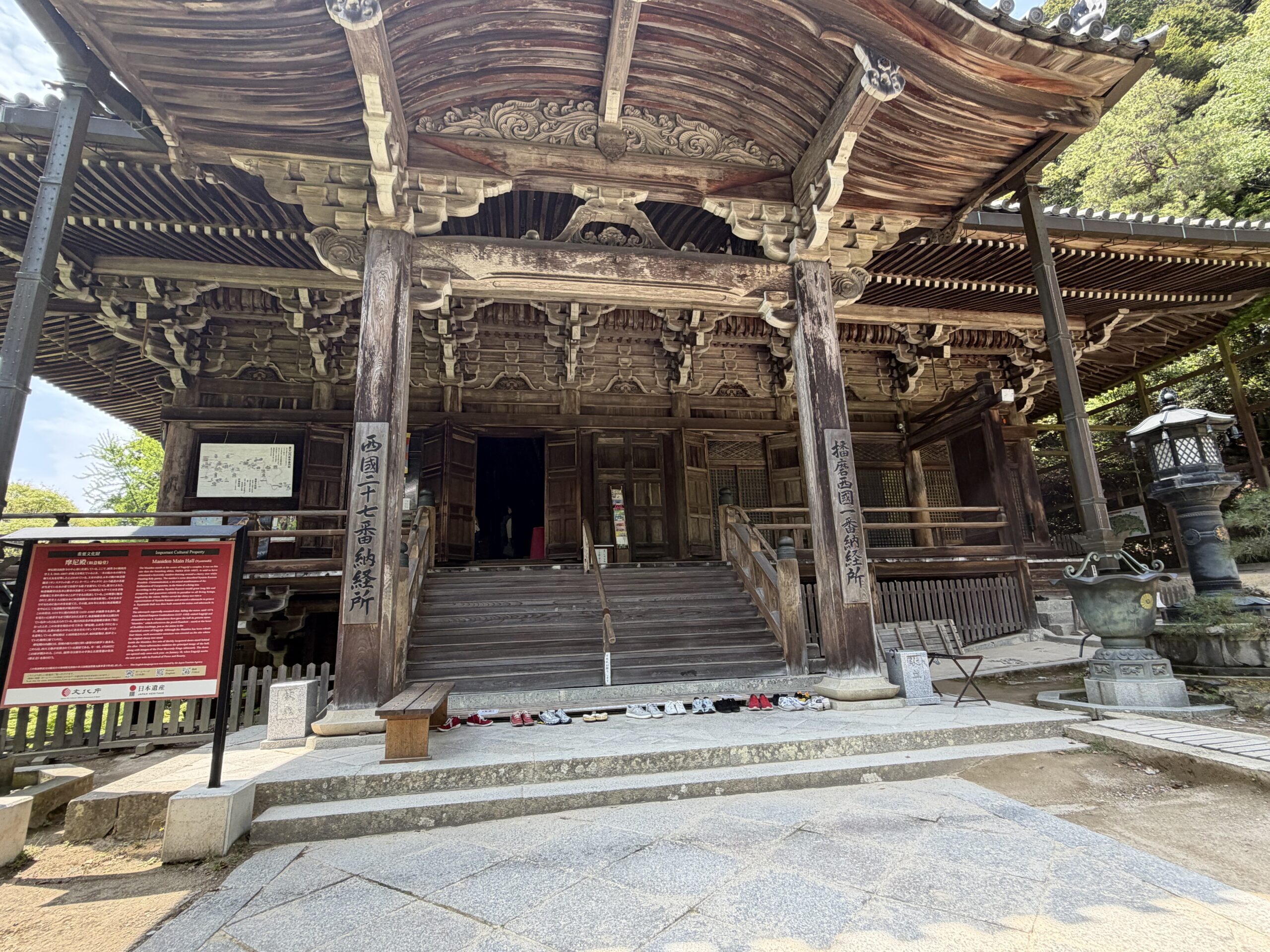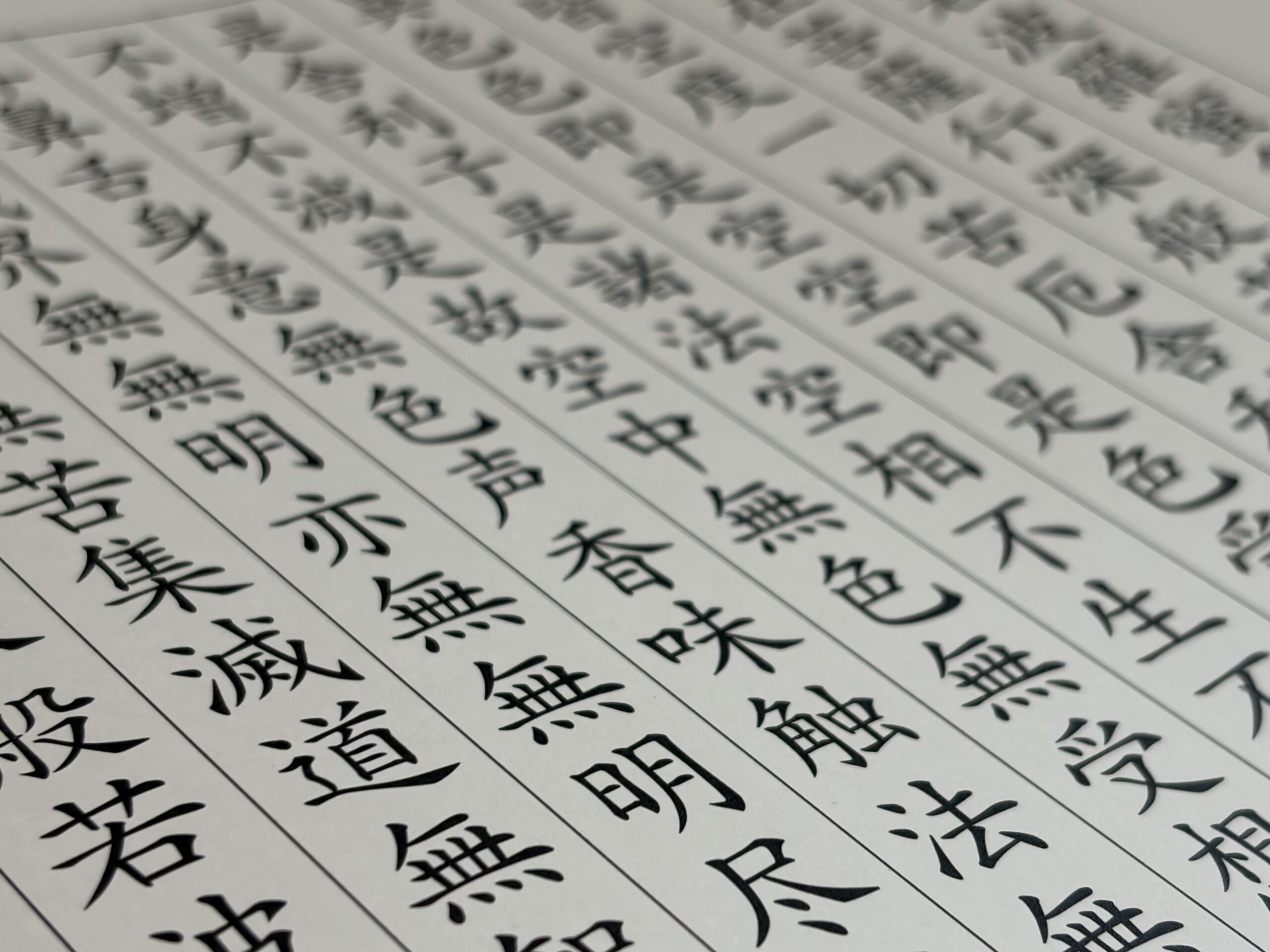
Since beginning my pilgrimage along the Saikoku Thirty-Three Temples, I have had the opportunity to practice shakyō (sutra copying), and it has renewed my interest in the Heart Sutra (Hannya Shingyō).
I will be having an AI write a supporting article about the Heart Sutra. The photographs will be my own originals.
Just over 260 characters long — shorter than many text messages — the Heart Sutra is said to contain the entire essence of Mahayana Buddhism within its compact frame. On pilgrimages such as the Saikoku Sanjūsansho (the thirty-three sacred temples of western Japan) and at temples across the country, it is still chanted daily. Many people have heard its name without ever knowing what lies inside it. Digging a little deeper into this famous scripture reveals a world far more layered and profound than its brevity suggests.
What Is the Heart Sutra? Understanding the Basics
The Heart Sutra is known in Sanskrit as Prajñā-pāramitā-hṛdaya (pronounced roughly “Prajnya-paramita-hridaya”). Among all the scriptures in the Buddhist canon, it is one of the very shortest. Yet within that single brief volume, the doctrines of Mahayana Buddhism are said to be entirely contained — a remarkable claim for a text you can recite in a couple of minutes.
Its background helps explain that claim. The Mahāprajñāpāramitā Sūtra (in Japanese, Daihannya Haramitta-kyō) runs to a monumental 600 volumes, all pursuing the philosophy of emptiness. The Heart Sutra is positioned as the distilled essence of that vast body of teaching, compressed into a single short scroll. Precisely because it concentrates so much into so little, it has been chanted continuously across the centuries and remains beloved today.
The Full Name and Its Abbreviations
In Japan, the scripture is generally referred to by the shortened name Hannya Shingyō (般若心経). This can be abbreviated even further to simply Shingyō (心経, “Heart Sutra”). While the Chinese-translated title includes the character for “sutra” (経, kyō), some Buddhist schools add the prefix Bussetsu (仏説), meaning “spoken by the Buddha,” rather than using the plain title alone.
As a result, you may encounter the text under several names:
- Bussetsu Maka Hannya Haramitta Shingyō (仏説摩訶般若波羅蜜多心経)
- Maka Hannya Haramitta Shingyō (摩訶般若波羅蜜多心経)
- Hannya Shingyō (般若心経)
- Shingyō (心経)
There is an intriguing detail here that scholars still find noteworthy. The oldest surviving Chinese-translated text is carved on a stone monument at Kōfuku-ji temple. On that monument, the title at the beginning reads Hannya Haramitta Shingyō, yet where the title is written again at the close of the text, the wording differs. Small inconsistencies like this are exactly the kind of clue that keeps researchers fascinated by this ancient scripture.
What Does the Full Text of the Heart Sutra Mean?
Of all the lines in the Heart Sutra, none is more famous than the declaration that “form is emptiness, emptiness is form.” This single phrase is widely recognized as a concentrated expression of the doctrine of kū (空, emptiness), which lies at the very foundation of Mahayana Buddhism.
The principle of emptiness is, in truth, endless to pursue. Its exploration gave rise to enormous scriptures such as the 600-volume Mahāprajñāpāramitā Sūtra. And yet the core of all of it is gathered into this one short scroll — herein lies the astonishing power of the Heart Sutra. Its density is one reason it is so often the first scripture that students of Buddhism pick up.
The Worldview Behind “Form Is Emptiness”
The words “form is emptiness, emptiness is form” express a way of seeing the world in which all things with shape have no fixed substance and are constantly changing. The philosophy of emptiness — the idea that things possess no permanent, unchanging essence — sits at the heart of Mahayana Buddhist thought. It is less a bleak nihilism than an invitation to see reality as fluid, interconnected, and alive with possibility.
Something interesting happens when the sutra is chanted aloud on pilgrimage. Practitioners describe how repeating this short text over and over lets the body absorb its rhythm and resonance before the intellect fully grasps its meaning. In this sense, the very act of recitation — of voicing the words again and again — becomes a path toward internalizing the teaching, rather than merely studying it on paper.
Who Translated the Heart Sutra into Chinese?
The version of the Heart Sutra commonly seen in Japan comes from the Chinese translation by Xuanzang (in Japanese, Genjō Sanzō), the great pilgrim-monk who journeyed to India. The furigana readings attached to the characters vary slightly from one Buddhist school to another, which is why chanting can sound a little different depending on where you hear it.
Historically, however, the translation attributed to Kumārajīva (Kumarajū) — titled Maka Hannya Haramitsu Daimyōju-kyō — was generally regarded as the oldest surviving Chinese rendering. Records also refer to texts such as Maka Hannya Haramitsu Shinju (one volume) and a variant edition of Hannya Haramitsu Shinju (one volume). Some scholars propose, based on these, that ritual practices centered on shu (呪, incantations or dhāraṇī) existed even before the Heart Sutra took shape as a formal scripture.
The Scholarly Debate Over Its Origins
The question of how and where the Heart Sutra originated has been debated in academic circles worldwide for many years, and it remains far from settled. The researcher Jan Nattier put forward a provocative theory: noting that the main text of Xuanzang’s Heart Sutra matches Kumārajīva’s translation of the Mahāprajñāpāramitā Sūtra word for word, she argued that someone compiled the Heart Sutra from Kumārajīva’s Chinese translation, that Xuanzang then revised only certain specific terms — such as Kanjizai (観自在, Avalokiteśvara) and un (蘊, the aggregates) — and that the result was subsequently translated back into Sanskrit.
This theory did not go unchallenged. In July 1994, Fumimasa Fukui presented a rebuttal at the national conference marking the tenth anniversary of the Japanese Association for Buddhist Thought. In 1995, Noriyuki Kudō introduced the outline of Nattier’s argument while explicitly stating that he did not endorse her conclusions. A Japanese translation of Nattier’s paper, prepared by Noriyuki Kudō and Takamichi Fukita, did not appear until 2006.
The question “Did Xuanzang translate a Chinese Heart Sutra, or the other way around?” continues to attract new evidence and fresh perspectives. It is, in other words, a living field of research rather than a closed chapter of history.
The Oldest Manuscript: The Hōryū-ji Text
No account of how the Heart Sutra was transmitted would be complete without the palm-leaf manuscript preserved at Hōryū-ji temple. Written on baiyō (貝葉, palm leaves), the Hōryū-ji Palm-Leaf Heart Sutra (法隆寺貝葉心経) contains the text of the Heart Sutra from the first leaf (upper section) through to the first line of the second leaf (lower section).
According to the Tokyo National Museum, this manuscript dates to the post-Gupta period, in the 7th to 8th centuries. It is known as the Hōryū-ji text (or the Hōryū-ji Palm-Leaf Heart Sutra). No manuscript older than the Chinese translations has been discovered, which underscores just how precious this artifact is.
- Dated to the post-Gupta period, 7th–8th centuries
- No manuscript predating the Chinese translations has been found
- Damage has made many passages difficult to read
- Numerous proposed readings have been offered by scholars since the Edo period
Because of its great age, the manuscript is heavily damaged, and many sections remain hard to decipher. The fact that scholars have been proposing competing interpretations of it ever since the Edo period speaks volumes about how highly this single scroll has been valued. Other manuscripts of the Heart Sutra also survive in Japan, but these are considered to date from considerably later times.
Why Chant the Heart Sutra on the Saikoku Pilgrimage?
On pilgrimages such as the Saikoku Sanjūsansho — the circuit of thirty-three temples across western Japan sacred to the bodhisattva Kannon — chanting the Heart Sutra at each temple is a long-established custom. Precisely because it is so short, pilgrims can recite it comfortably during pauses in their walking or while standing before the main hall of each temple.
As a text held to embody the very essence of Mahayana Buddhism and chanted continuously through the ages, the Heart Sutra pairs remarkably well with the act of pilgrimage — a journey undertaken one step at a time. Each time the words are voiced aloud, the pilgrim draws a little closer to the teaching of emptiness. It is this accumulation of small, repeated experiences that gives the pilgrimage road so much of its depth and meaning.
Frequently Asked Questions
- Q: How long is the Heart Sutra?
- A: The Heart Sutra is one of the very shortest texts in the entire Buddhist canon, at just over 260 characters. Despite its brevity, it is said to contain the whole of Mahayana Buddhist doctrine within a single short volume.
- Q: What does “form is emptiness” (色即是空) mean?
- A: The phrase “form is emptiness, emptiness is form” expresses the view that all things with shape have no fixed, permanent substance and are constantly changing. It is a concise statement of the doctrine of emptiness (kū) at the core of Mahayana Buddhism.
- Q: Who translated the Heart Sutra into Chinese?
- A: The version most widely used in Japan is the Chinese translation by Xuanzang (Genjō Sanzō). Historically, a translation attributed to Kumārajīva was regarded as the oldest surviving Chinese rendering, and scholarly debate over the sutra’s origins continues to this day.
- Q: What is the oldest surviving manuscript of the Heart Sutra?
- A: The palm-leaf (baiyō) manuscript at Hōryū-ji temple, dated by the Tokyo National Museum to the post-Gupta period (7th–8th centuries), is the oldest known. No manuscript older than the Chinese translations has been found.
- Q: Why is the Heart Sutra chanted during pilgrimages?
- A: Its brevity makes it easy to recite at each temple along routes such as the Saikoku Sanjūsansho. As a text embodying the essence of Mahayana Buddhism, it suits the rhythm of a pilgrimage undertaken step by step.
Conclusion
For a scripture that fits comfortably on a single page, the Heart Sutra carries an extraordinary weight of meaning and history. In just over 260 characters it distills the emptiness philosophy that fills 600 volumes of the Mahāprajñāpāramitā Sūtra; behind its familiar chant lie a translator as famous as Xuanzang, a lively scholarly debate reaching from Edo-period Japan to Jan Nattier’s modern research, and a fragile 7th- to 8th-century palm-leaf manuscript preserved at Hōryū-ji.
What makes the sutra endure, though, is not only its scholarly interest but its living practice. Voiced aloud at temple after temple along the Saikoku pilgrimage route, its words are absorbed through the body as much as the mind. If you ever find yourself before the main hall of a Japanese temple and hear that steady, rhythmic chant rising into the air, you will be listening to one of the shortest — and deepest — texts in all of Buddhism.