
In late 2017, I began preparing to practice wearing kimono. By March 2018, I reached out to a dressing instructor I had studied with years before and resumed my lessons.
At the same time, I realized I knew almost nothing about kimono itself — the fabrics, the formality rules, how to care for them. There was so much I didn’t understand. Fortunately, around that same time, I happened to reunite by chance with a kimono dressing instructor, and she became my guide into this world.
My Goal: Kimono as Part of Daily Life
What I truly wanted was to wear kimono as part of everyday life — not just on special occasions.
Wearing a hōmongi (formal visiting kimono) on celebratory days is of course wonderful, but what I longed for first was casual kimono for daily wear. My grandmother wore kimono every single day. My mother used to tell me she once did housework in kimono. Those images stayed with me.
Even so, I had no concrete idea of what “casual kimono” actually meant in practice. I didn’t know about formality levels for kimono or obi (sash), fabrics, how to coordinate outfits, or how to care for them. I knew absolutely nothing.
At that point, I was simply someone with a deep wish to wear kimono — someone who had stepped up to the starting line without knowing which direction to run. I didn’t even know that concepts like fudan-gi (everyday kimono) or “casual kimono” existed.
It was the instructor I happened to reunite with who taught me everything about how to build a relationship with kimono in daily life.
Real Life in Kimono Means Real Knowledge
Once you actually start wearing kimono in everyday life, you quickly realize how much you don’t know. Even something as basic as caring for a kimono after wearing it is a mystery at first. The same goes for undergarments, juban (the under-kimono), and the many small accessories that go with kimono.
I hadn’t grown up surrounded by kimono in daily life, so not knowing was entirely natural. And yet, as a Japanese person, I was genuinely taken aback to discover how little I understood about something so fundamentally Japanese.
Organizing Study Sessions to Learn What We Didn’t Know
To fill those gaps, I began organizing small study sessions and seminars, as I had done in my own work as an independent instructor. I’d invite a specialist, gather interested people around me, and learn together.
YouTube and the internet have a huge amount of information on kimono, and much of it is accurate — but different sources sometimes offer conflicting opinions or approaches. For a complete beginner, it’s hard to know how to interpret it all. My advice: find one trusted teacher first, and build a solid foundation with her guidance before branching out.
Our study sessions covered a wide range of topics:
Kimono and obi — we started by having the instructor look at the kimono I already owned, identifying what type each one was. I didn’t know that tsumugi and komon are casual kimono, or that the general rule is to pair woven kimono with dyed obi. These are basics in the kimono world, but they were completely new to me.
Learning from real garments in front of you is far more effective than reading about them in a book. The instructor once brought along a kimono that had been washed and unstitched back into bolt form (arai-hari), as well as a rain coat that had originally been a man’s Ōshima tsumugi — invaluable things for a beginner to see up close.
We also covered kimono care, juban, undergarments, and accessories of all kinds. I asked every question I could think of.
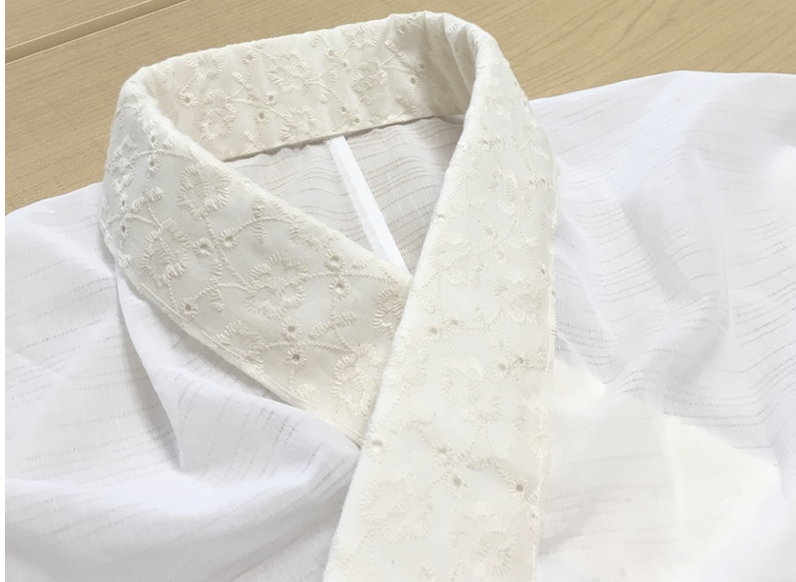
One early challenge for many kimono beginners is han-eri — the decorative collar shown at the neckline. We held a hands-on session where participants actually attached a lace han-eri themselves, which was both fun and incredibly useful.
Shopping Tours to Learn About Recycled Kimono
Not long after I began practicing kimono dressing, we organized shopping tours focused on recycled kimono.
At the time, the concept of “recycled kimono” (risaikuru kimono) was completely new to me. Just walking into a recycled kimono shop and shopping there was a valuable experience in itself.
Walking into a traditional kimono shop as a beginner feels intimidating, and most beginners don’t have a regular shop they know. Recycled kimono shops have a lower barrier to entry — but even so, going alone as a beginner without any knowledge is still daunting.
So the instructor took us to shops she knew well, and guided us through what to look for at each one. Being able to check actual garments with expert guidance — and getting your questions answered right there on the spot — is a chance to learn living, practical knowledge in real time.
I ended up joining about four shopping tours, spread across different seasons. Going across seasons meant I built up knowledge about kimono throughout the year, not just for one time of year. I highly recommend joining a shopping tour led by a kimono dressing instructor if you ever have the chance.
I also had my previous dressing teacher take me on a shopping tour earlier — but several years had passed since then, and my memory had become hazy. Joining multiple tours over time refreshes and deepens your real-world knowledge, and builds the confidence to eventually shop on your own.
Practice Hard with Inexpensive Recycled Kimono
For daily practice, I used old recycled kimono and obi I had picked up for as little as 100 to 500 yen each. My goal was to repeat the dressing process so many times that my hands would move naturally, without having to consciously think through each step. (I say this with some confidence, but even now I occasionally forget to put on the obi-age — so there’s always room to grow.)
With intensive practice, obi develop creases and wear, and obi-jime cords get damaged. The kimono itself takes strain at certain points and can tear. For guilt-free, unreserved practice, inexpensive old pieces are ideal.
Save your good kimono for when you’re more skilled.
From Casual Beginnings to a Formal Party — One Year Later
2018 was the year I built my foundation in everyday kimono. In April I created my first opportunity to go out in kimono, and from there I began organizing lunch gatherings and outings.
I had already been organizing seminars and events in my work, so putting together kimono-related events wasn’t a burden. Even if only one or two people joined, I was happy. And gradually, women of my generation who shared the interest began participating — something I’m truly grateful for.
As I continued creating opportunities to wear kimono, I also kept creating opportunities to deepen my knowledge.
Starting from the position of “everyday, casual kimono” turned out to be exactly the right choice for me.
In formal settings — weddings and the like — it’s perfectly fine to have someone else dress you. I later had a professional dress me in a formal black tomesode for a wedding.
The situations in daily life that require you to dress yourself in formal kimono are almost nonexistent.
So for the beginning, casual kimono dressing is more than enough.
Challenging Formal Kimono After Getting Comfortable with Casual
About a year in, one participant expressed a wish to wear hōmongi (formal visiting kimono) to a hotel lunch. So I organized one — and for the first time, I took on the challenge of dressing in yawarakamono (soft, draped silk kimono).
I found a komon (small-pattern) kimono and obi at a recycled shop, and began practicing three days before the event. A month beforehand, I organized a special lesson focused on dressing in soft silk kimono.
If I had tried to start with formal silk kimono from the very beginning, I’m quite sure I would have given up in frustration.
Having built my skills with tsumugi first, I was able to manage with just a few days of focused practice. And by the second year, I finally understood what experienced kimono wearers mean when they speak of the indescribable comfort and pleasure of soft silk against the skin.
Starting from casual, everyday kimono was absolutely the right decision.
I am deeply grateful to both instructors who guided and supported me along this journey.