Standing inside a dimly lit temple hall, surrounded by rows of golden figures, many visitors find themselves wondering the same thing: why does one statue look serene and almost naked, while the next glares with bulging eyes and brandishes a sword? Understanding the difference between Nyorai, Bosatsu, Myoo, and Ten—the four ranks of Buddhist statues in Japan—turns a confusing crowd of figures into a story you can actually read. These four categories form the backbone of Esoteric Buddhism (known as Mikkyo) and reveal a surprisingly logical hierarchy of the divine.
The system was firmly established in Japan by the monk Kukai (Kobo Daishi), who brought Shingon Esoteric Buddhism back from Tang China in the early 9th century. Once you learn the visual clues, you’ll never look at a temple statue the same way again.
Do Buddhist Deities Have a Ranking System?
Japanese Buddhism venerates a staggering number of deities—far too many for any single visitor to memorize. To bring order to this vast pantheon, Shingon Buddhism sorts them into four broad groups: Nyorai (如来), Bosatsu (菩薩), Myoo (明王), and Ten (天). In the world of religious sculpture, these are sometimes referred to collectively as the shisho (the “four sacred ranks”).
Think of it as a spiritual organizational chart, arranged by stage of enlightenment and function. The most famous place to experience this hierarchy in person is the Lecture Hall (Kodo) at To-ji Temple in Kyoto. There, Kukai arranged 21 statues into a three-dimensional mandala (rittai mandara)—a physical map of the cosmos that lets you walk through the Esoteric worldview rather than just read about it. Let’s go through the four ranks one by one.
1. Nyorai — The Fully Enlightened, the Highest Rank
Nyorai sit at the very top. Having already achieved complete enlightenment, they represent the goal of the entire Buddhist path. Familiar examples include Shaka Nyorai (the historical Buddha), Dainichi Nyorai (the Cosmic Buddha), Amida Nyorai, and Yakushi Nyorai, the Buddha of healing.
The easiest way to spot a Nyorai is its plainness. These figures are modeled on the Buddha after he renounced worldly life, so they wear almost no ornamentation—just a simple draped robe. Look at the head, too: the tight, snail-shell curls are called rahotsu, and they’re a dead giveaway. One famous exception breaks every rule: Dainichi Nyorai, the central deity of Esoteric Buddhism, is depicted wearing a jeweled crown and lavish ornaments, as if to signal that he reigns over the entire universe.
- Minimal ornamentation; simple monastic robe
- Hair styled in tight rahotsu curls
- Exception: Dainichi Nyorai appears in royal regalia
2. Bosatsu — Still in Training, Devoted to Saving Others
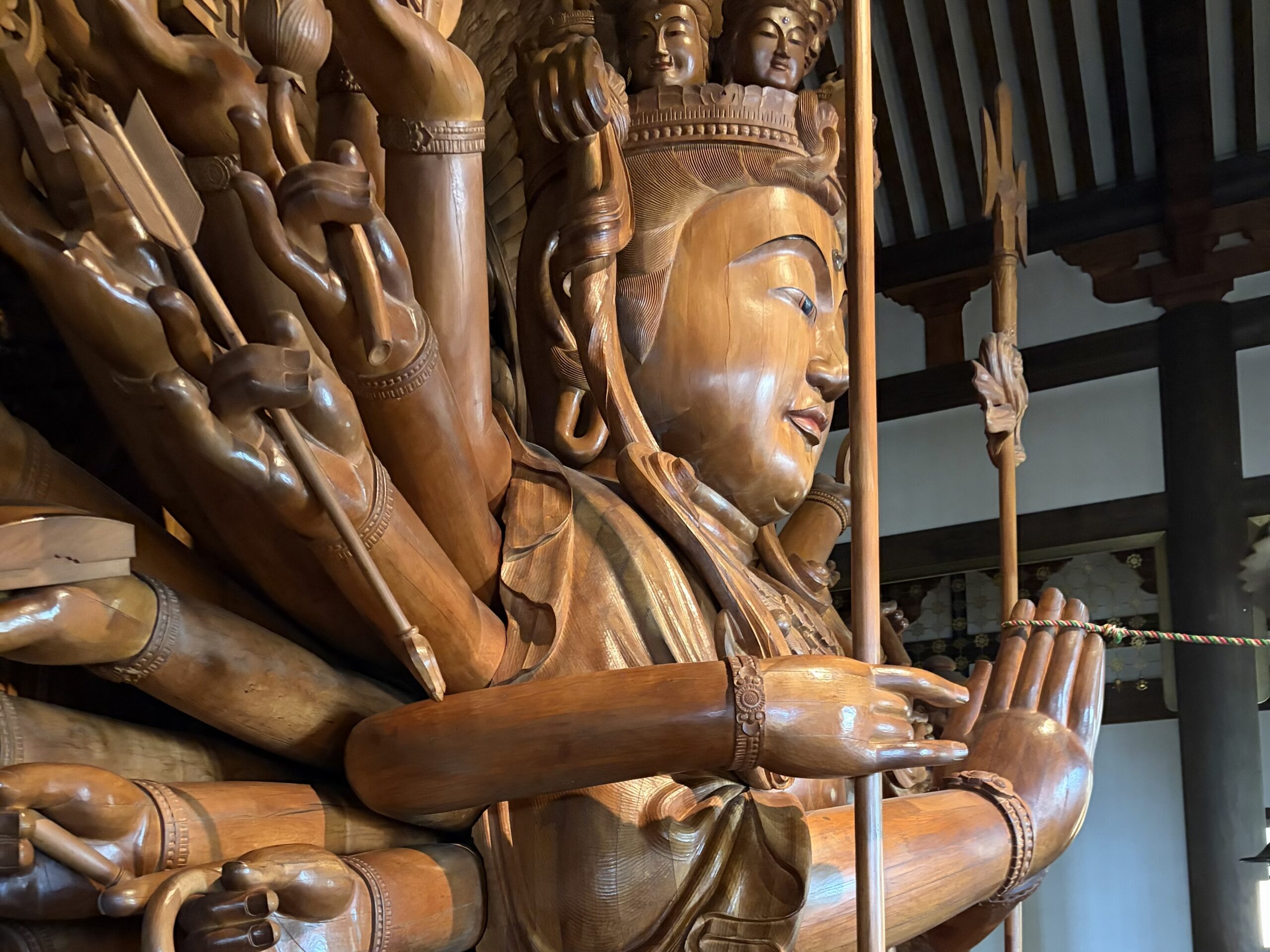
Bosatsu (Bodhisattvas in Sanskrit) occupy the second rank. They are beings who actively pursue enlightenment while simultaneously working to rescue ordinary people from suffering. The much-beloved Kannon (the Bodhisattva of Compassion), Miroku, Jizo, and Monju all belong here.
Visually, Bosatsu are modeled on Prince Siddhartha—the historical Buddha before he gave up his princely life. That’s why they’re decked out in elaborate crowns, necklaces, and bracelets. Stand before the glittering Kannon statues at temples around Japan and the contrast with a plain Nyorai becomes obvious at a glance. A small insider’s tip: Jizo is the odd one out among Bosatsu, often shown as a humble shaven-headed monk rather than a bejeweled prince, because of his vow to wander the earth saving even those in hell.
3. Myoo — The Wrathful Guides of Esoteric Buddhism
Myoo (“Wisdom Kings”) are a distinctly Esoteric innovation—you won’t find them in older forms of Buddhism. Their job is to handle the stubborn cases: people who refuse to listen to gentle teaching. To shock them onto the right path, Myoo deliberately adopt a terrifying appearance. The most prominent is Fudo Myoo, followed by Gozanze Myoo and Aizen Myoo.
Most Myoo are considered manifestations of Dainichi Nyorai himself. They are wrapped in flames, grip weapons, and bare their fangs in a furious expression known as funnuso. The fierceness is only a surface; behind it lies profound compassion. At Naritasan Shinshoji Temple in Chiba, Fudo Myoo serves as the principal image for the dramatic goma fire ritual, which still draws crowds of worshippers who watch flames leap as priests chant. When you witness a goma ceremony in person, that “scary” face suddenly reads as fierce protective love rather than anger.
4. Ten — The Guardian Gods Who Protect Buddhism
Ten are the most down-to-earth of the four groups. Originally Indian deities from Brahmanism and Hinduism, they were absorbed into Buddhism as protective guardians of the Dharma and its followers. Because they sit closest to the human realm, their forms vary wildly.
This group includes Bonten (Brahma), Taishakuten (Indra), Bishamonten, Benzaiten, Daikokuten, and Kichijoten, among many others. Some appear as armored warriors ready for battle; others, like the graceful goddess Benzaiten, are serene and elegant. Here’s a fact that delights many visitors: most of Japan’s Seven Lucky Gods (the Shichifukujin) actually belong to this Tenbu category. The famous Ashura statue at Kofuku-ji Temple in Nara—with its three faces and six arms—is broadly classified within this guardian group, and it remains one of the most photographed Buddhist sculptures in all of Japan.
How to Tell the Four Groups Apart at a Glance
Here’s a quick cheat sheet to keep in mind on your next temple visit:
- Nyorai: Plain robe, rahotsu curls, highest rank (Dainichi being the lavish exception)
- Bosatsu: Glittering jewelry, princely appearance
- Myoo: Wrathful face, flames, weapons in hand
- Ten: Wildly varied—armored warriors or elegant goddesses, all serving as guardians
The two fastest clues are ornamentation and facial expression. Ask yourself: Is the figure decorated or plain? Is the face calm or furious? Answer those two questions and you can usually slot any statue into the right group within seconds.
Frequently Asked Questions
- Q: Which Buddhist deity is the most supreme?
- A: In Shingon Esoteric Buddhism, Dainichi Nyorai is regarded as the cosmic, fundamental Buddha and the highest of all. Every other deity is believed to emanate from him, which is why he alone among the Nyorai is shown in jeweled royal attire.
- Q: Is Kannon a Nyorai or a Bosatsu?
- A: Kannon is classified as a Bosatsu (Bodhisattva). Though still on the path to full enlightenment, Kannon devotes that journey to saving suffering people, which has made this deity one of the most popular figures in all of Japanese Buddhism.
- Q: Why does Fudo Myoo have such a frightening face?
- A: The fierce expression is a teaching tool. For people who won’t respond to gentle words, Fudo Myoo adopts a terrifying form to force them onto the righteous path. Beneath the wrath lies deep compassion.
- Q: Are the Seven Lucky Gods part of the Buddhist pantheon?
- A: Several of them—Bishamonten, Benzaiten, and Daikokuten—belong to the Tenbu (Ten) group of Buddhist guardian deities. However, the lineup is a mix: Ebisu, for instance, is a native Japanese (Shinto) god, so the Seven Lucky Gods are actually a blend of different religious origins.
- Q: Where is the best place to see all four groups together?
- A: The Lecture Hall at To-ji Temple in Kyoto is ideal. Kukai’s three-dimensional mandala arranges Nyorai, Bosatsu, Myoo, and Ten statues together, letting you compare all four ranks side by side in a single space.
Conclusion
Nyorai, Bosatsu, Myoo, and Ten are the four ranks that organize the role and status of deities within Esoteric Buddhism. Keep the basic logic in mind—”the enlightened Nyorai,” “the still-training Bosatsu,” “the wrathful guiding Myoo,” and “the protective Ten”—and every temple hall transforms into a readable map of the spiritual cosmos. Next time you stand before a row of statues, take a moment to study the ornaments and the expressions. Chances are, you’ll spot details you’ve walked past a dozen times before and finally understand exactly what you’re looking at.
References
- To-ji (Kyoogokokuji) Official Website
- Naritasan Shinshoji Temple Official Website
- Kofuku-ji Temple Official Website
Introduction & Overview
- What Is Esoteric Buddhism? Tendai and Shingon Explained in Simple Terms
- The Deep Connection Between the Saigoku Pilgrimage and Esoteric Buddhism | Why We Journey to Kannon Bodhisattva
Buddhas & Bodhisattvas
- What Are the 33 Forms of Kannon Bodhisattva? A Complete Guide to the Principal Images of the Saigoku Pilgrimage
- What Is the Difference Between Nyorai, Bosatsu, Myōō, and Ten? An Illustrated Guide to the Deities of Esoteric Buddhism
Practices & Culture
- The Meaning of the Heart Sutra Explained Simply | The World of the Sutras Chanted on Pilgrimage
- What Are Goshuin, Omiei, and Sange? The Esoteric Buddhist Culture You Encounter on the Saigoku Pilgrimage
Temples & History