The Saikoku Thirty-Three Kannon Pilgrimage (Saikoku Sanjūsansho) and Japanese esoteric Buddhism share a bond that runs far deeper than most casual visitors ever realize. This 1,000-kilometer circuit through the Kansai region is widely considered the oldest pilgrimage route in Japan, and for more than a thousand years it has drawn emperors, poets, farmers, and—these days—Instagram-loving twenty-somethings. So why does walking from one Kannon temple to the next still move people so profoundly? The answer lies in a quiet fusion of devotion to Kannon, the Bodhisattva of Compassion, and the rituals of Mikkyō (密教), Japan’s esoteric Buddhist tradition.
What Is the Saikoku 33 Kannon Pilgrimage?
The Saikoku route links 33 temples dedicated to Kannon (観音菩薩, the Bodhisattva of Compassion) across the two metropolitan prefectures and four prefectures of Kansai, plus a final stretch into Gifu Prefecture. The journey begins at Temple No. 1, Seiganto-ji in Wakayama—a temple perched dramatically beside the towering Nachi Falls—and concludes at Temple No. 33, Kegon-ji in Gifu, where pilgrims receive their kechigan (結願), the certificate of completion.
According to tradition, the pilgrimage traces back to the Nara period. In the year 718, a monk named Tokudō Shōnin of Hase-dera temple is said to have fallen gravely ill and met Enma, the king of the underworld. Enma handed him a sacred seal and a message: anyone who visits 33 Kannon sanctuaries can be reborn in the Pure Land. The story sounds like folklore, and perhaps it is—but the pilgrimage genuinely took hold among ordinary people between the late Heian and Kamakura periods, evolving from an aristocratic and clerical practice into something the common folk could embrace.
Why the Number Thirty-Three?
The figure 33 is no accident. The Lotus Sutra’s chapter on Kannon—the Kanzeon Bosatsu Fumon-bon, popularly called the Kannon Sutra—teaches that the bodhisattva transforms into 33 different forms to save sentient beings. This is why each temple enshrines a distinct manifestation of Kannon: the Sacred Kannon (Shō Kannon), the Thousand-Armed Kannon (Senju Kannon), the Eleven-Headed Kannon (Jūichimen Kannon), the Wish-Fulfilling Kannon (Nyoirin Kannon), and even the fierce, horse-headed Batō Kannon. Visiting all 33 temples is, in effect, encountering the full range of compassion’s faces.
How Is the Saikoku Pilgrimage Connected to Esoteric Buddhism?
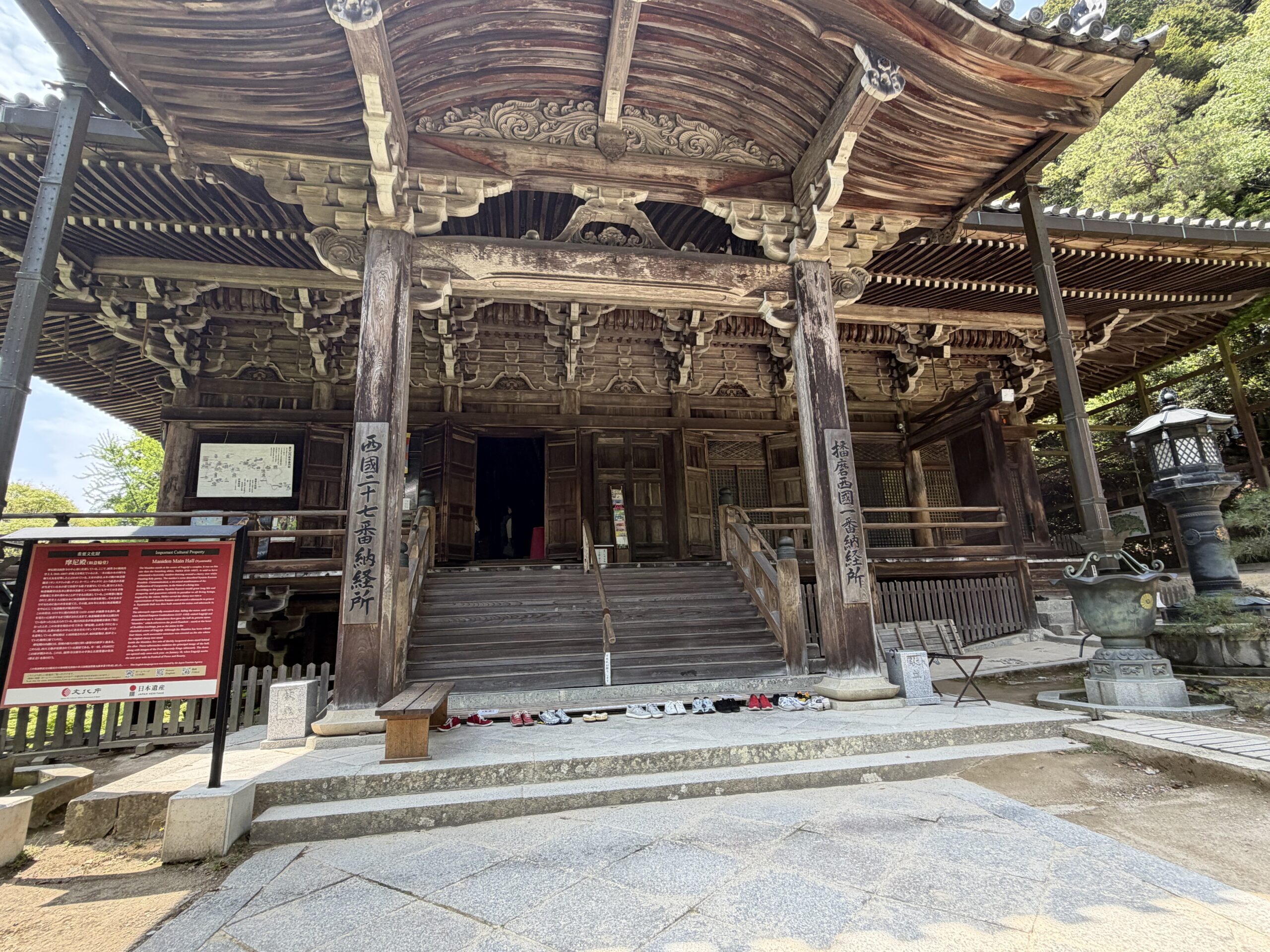
While the pilgrimage itself springs from the Lotus Sutra, the overwhelming majority of its temples belong to esoteric schools—Shingon (真言宗) and Tendai (天台宗). Arrive at almost any札所 (fudasho, or numbered temple) and you’ll notice something curious: alongside the main hall stands a separate Daishi-dō, a hall honoring Kūkai (Kōbō Daishi), the ninth-century founder of Japanese Shingon esotericism. That architectural pairing is the clearest physical proof that Kannon devotion and Mikkyō have grown together over the centuries.
Why So Many Shingon and Tendai Temples?
Sort the 33 temples by sect and Shingon-affiliated sites make up more than half, with Tendai temples close behind. Temple No. 11, Daigo-ji in Kyoto, is the head temple of the Daigo branch of Shingon and a registered UNESCO World Heritage Site. Temple No. 16, the famous Kiyomizu-dera, originally belonged to the Hossō school but became a major center of Kannon worship thanks to its Thousand-Armed Kannon.
Esoteric Buddhism places enormous weight on ritual and on shingon (真言, mantras) as a means of becoming one with the deity. The mantra chanted before the Thousand-Armed Kannon—”On bazara darma kiriku”—is pure esoteric practice. Even the small slips of paper called osamefuda (納め札), which pilgrims deposit at each temple before receiving a stamp, are rooted in the Mikkyō concept of kechien (結縁): forging a karmic bond with the deity. When practitioners describe the act, they often say it feels less like sightseeing and more like introducing yourself, again and again, to compassion itself.
Walking the Pilgrimage as a Living Mandala
Here’s an interpretation worth sitting with. Many devotees have long understood the act of touring all 33 sites as walking a three-dimensional mandala. If an esoteric mandala renders the cosmos of the buddhas on a flat surface, then the Kannon sanctuaries scattered across Kansai form a colossal mandala drawn upon the land itself. The road from Temple No. 1 to the final kechigan becomes a symbolic passage from the world of delusion toward awakening. Pilgrims who have completed the full circuit often remark that the geography stops feeling like a map and starts feeling like a meditation.
What Do You Gain From the Saikoku Pilgrimage?
Beyond the spiritual dimension, the practical rewards are abundant. There is the simple joy of collecting goshuin (御朱印)—the elegant calligraphy-and-seal stamps unique to each temple—alongside encounters with seasonal landscapes and centuries-old architecture. The recent goshuin boom has brought a wave of younger visitors in their twenties and thirties, proof that the route is anything but a relic.
- Each temple offers a different form of Kannon and its associated blessings (goriyaku).
- The goshuin stamps and goeika (御詠歌, devotional pilgrimage hymns) connect you to centuries of faith.
- Literary landmarks like Hase-dera and Ishiyama-dera reward the curious traveler.
- Whether on foot or by car, you set your own pace.
Temple No. 13, Ishiyama-dera, is celebrated as the place where Murasaki Shikibu is said to have conceived The Tale of Genji while gazing at the moon. Knowing these cultural threads before you arrive deepens the experience immeasurably—suddenly a quiet temple veranda becomes the birthplace of the world’s first novel.
Frequently Asked Questions
- Q: How long does it take to complete the Saikoku pilgrimage?
- A: By car, expect roughly one week to ten days. On foot, it can take a month or more. Many people opt for kugiri-uchi, tackling a few temples each weekend over many months or even years.
- Q: Is there a required order for visiting the temples?
- A: The most common approach is jun-uchi, starting at Temple No. 1 and proceeding in numerical order. However, you’re free to visit in whatever sequence suits your schedule—there is no obligation to follow the numbers.
- Q: Can I take part without any knowledge of esoteric Buddhism?
- A: Absolutely. Simply pressing your palms together before the principal image and chanting the mantra is more than enough to make the pilgrimage meaningful. Each temple posts guidance on the correct shingon.
- Q: How does this differ from the Shikoku 88-temple pilgrimage?
- A: The Shikoku circuit follows temples linked to Kōbō Daishi (Kūkai), while Saikoku is devoted to Kannon. That said, both are steeped in esoteric Buddhist elements, so the two routes feel like cousins rather than strangers.
Conclusion
The Saikoku Thirty-Three Kannon Pilgrimage is Japan’s oldest sacred route, born from the belief that Kannon takes 33 compassionate forms to rescue the suffering. Woven through its practice—mantras, stamps, and the forging of karmic bonds—are the living threads of esoteric Buddhism. To walk all 33 temples is to trace a mandala drawn across the earth, a journey of the spirit as much as the feet. You needn’t begin as a devout pilgrim; entering through the doorway of goshuin collecting is perfectly fine. Why not step onto this thousand-year-old road of prayer and meet the many faces of compassion for yourself?
References
- Saikoku Thirty-Three Temple Pilgrimage Association (Official Site)
- Agency for Cultural Affairs, Japan
Introduction & Overview
- What Is Esoteric Buddhism? Tendai and Shingon Explained in Simple Terms
- The Deep Connection Between the Saigoku Pilgrimage and Esoteric Buddhism | Why We Journey to Kannon Bodhisattva
Buddhas & Bodhisattvas
- What Are the 33 Forms of Kannon Bodhisattva? A Complete Guide to the Principal Images of the Saigoku Pilgrimage
- What Is the Difference Between Nyorai, Bosatsu, Myōō, and Ten? An Illustrated Guide to the Deities of Esoteric Buddhism
Practices & Culture
- The Meaning of the Heart Sutra Explained Simply | The World of the Sutras Chanted on Pilgrimage
- What Are Goshuin, Omiei, and Sange? The Esoteric Buddhist Culture You Encounter on the Saigoku Pilgrimage
Temples & History